A New Perspective
“Edinburgh could be bleak, but Aberdeen really took the pish. A life could be wasted waiting for the sky tae change fae grey tae blue.”
Irvine Welsh, Skagboys
As a teenager, there was nothing I wanted more than to get out of Aberdeen—the grey city in the northeast of Scotland in which I grew up. I had a complicated relationship with the city from the start: we moved there from England when I was five years old, just myself and my parents, my brothers already out the door to university and beyond.
The move seemed to sequester me into an outsider’s role, both within this new, strange place and my own family. I was the only English child in my class, with a strong accent that gave me away immediately. My classmates were suspicious. They didn’t much like the English.
And within my family, I became the lone Scot. My brothers were firmly Mancunians, my mother Finnish, and my father southern English. I rejected this label throughout most of my childhood: it didn’t matter where I grew up, my family was English–Finnish, so I was English–Finnish. My brothers were from Manchester, so I was from Manchester.
Aberdeen never really felt like a home, but looking back, I don’t think I ever gave it a chance to. From the moment I stepped foot there, I was ready to leave. To find the place that belonged to me, that wasn’t chosen for me.
In January of this year, I returned to Aberdeen for my longest stint since I left at 18 years old. I never planned on spending six months living out of my (redecorated) childhood bedroom, down the road from my old high school, but in those six months, I rediscovered a city I’d been determined to ignore.
Granted, the buildings are a stern shade of grey unless the sun comes out (and the sun very rarely comes out). The once-thriving high street is a row of empty windows and a never-ending construction project. The seagulls are noisy and aggressive and God help you if you try and eat a prawn sandwich outside.
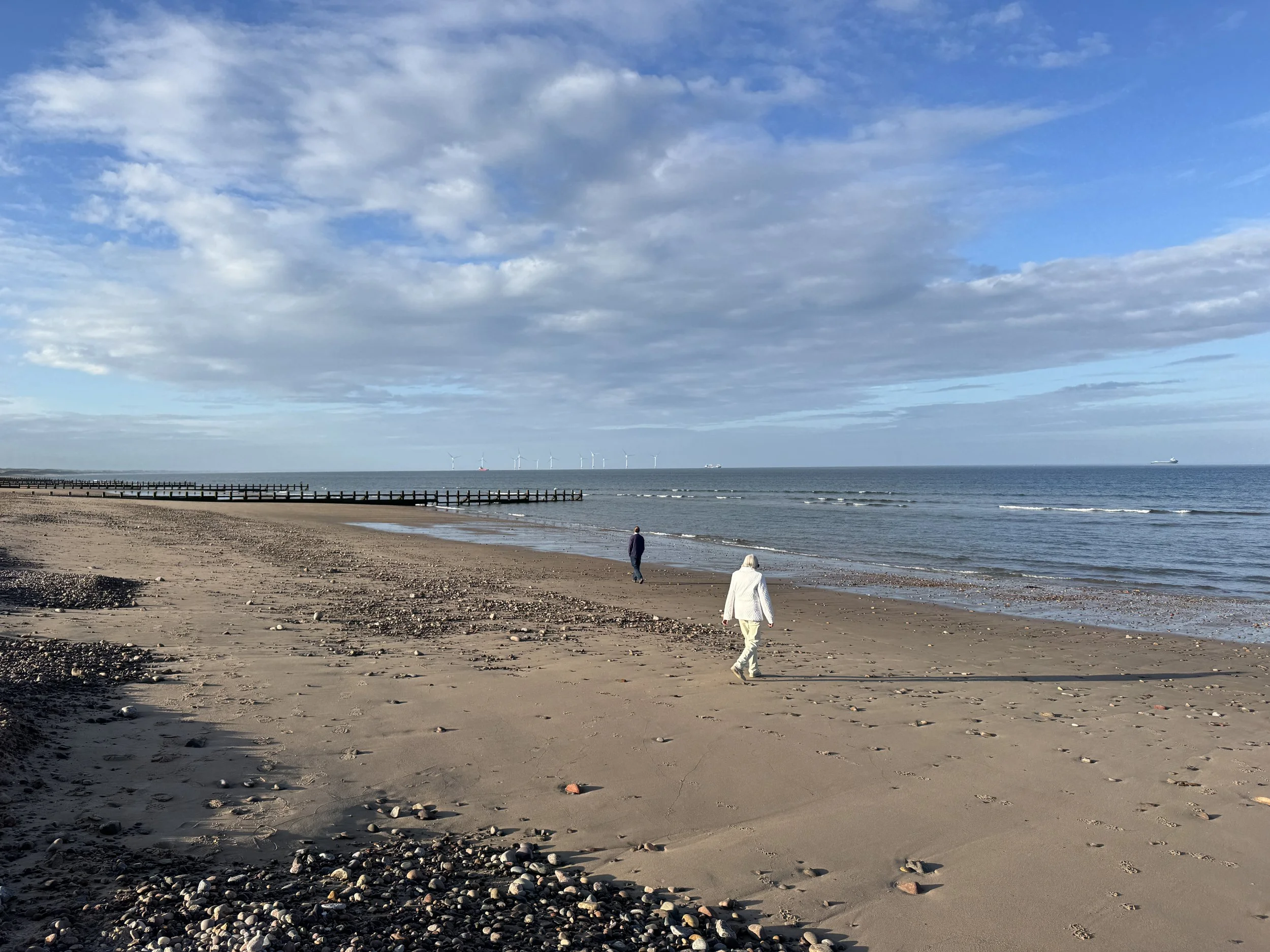
But carry on past the harbour and you reach the sea, and when the sun does come out, watch the people follow. See the families dash to the sand and roll up their trousers and dip their toes into the icy North Sea, just because they can. Look further down the beach and you’ll see the tree that washed up sometime ago, itself now a part of the fixtures. In the distance, ships weave past the dancing wind turbines.
Back in town, you’ll find the library, one of my favourite haunts in recent months. The carpet still smells like Saturdays of heavy canvas bags of paperbacks, and of picking the one VHS tape in your allowance for the week. Between rain showers and parades of bagpipers going past, I rewrite my gothic horror novel here, on funding from the Scottish government, to whom, yes—I am a Scot.
There is always a friendly smile to be found, when you need one. When I get knocked out by a pothole (of which there are many, watch your step) on a run and can’t walk, stuck on an island in the middle of a busy crossing, it is mere minutes before a stranger comes running to help. At the hospital, the nurses shake their heads over the deep incisions in my shin, and recommend a large glass of wine when I make it home.
That’s before you even mention the friends. On the night that the news of my big new chapter gets announced, I join my parents at a small party of my dad’s old colleagues from the university. Except they aren’t colleagues, they’re family. I have grown up around these people, my academic aunts and uncles and cousins, and it seems the right place to be on a night like that.
Many of my friends have moved away, just as I did. But those that remain are old friends, dear friends, who I see more now that I have in years. Friends that remind me who I am, and where I came from. I watch my first friend from Aberdeen get married; the first kind soul who sat down beside me on that first day of school, accent be damned, and took me in.
In these six months, I’ve developed an appreciation for the city that raised me, and for my own history, that I have never held. A pride for where I am from, even if it is part of a hodgepodge of a background that now also incorporates my status as a Canadian.
On one of the last nights before I leave, I find an old, unmarked CD while sorting boxes. It takes ten seconds, maybe less, once hitting play for me to know what it is: the live performance of my high school’s concert band. It might be the year we won the national title, although I can’t be sure.
That was another thing I hated: it was intensive rehearsals, led by a veritable dictator of a conductor who seemed to think he was conducting the national orchestra rather than a bunch of high schoolers with borrowed instruments shoved in their hands.
Listening now, I am taken aback. Because we were good. Really good. I’d never really noticed at the time. Hearing music that I must have practiced and performed over, and over, and over again, memory pulls out the feeling of it. I can remember that fiddly flute line, and the conductor shaking his head because we rushed the ending, again.
Even this is a part of me. I haven’t touched the flute in over a decade, but I learned a level of discipline and hard work in that band that also played its part in getting me to where I am today. Every single thing, stacked up, leading me to the doors of this next great opportunity.
So, I am grateful. For all of it.
Even the seagulls.