Casing the Joint
“We write to taste life twice, in the moment and in retrospect.”
Anaïs Nin
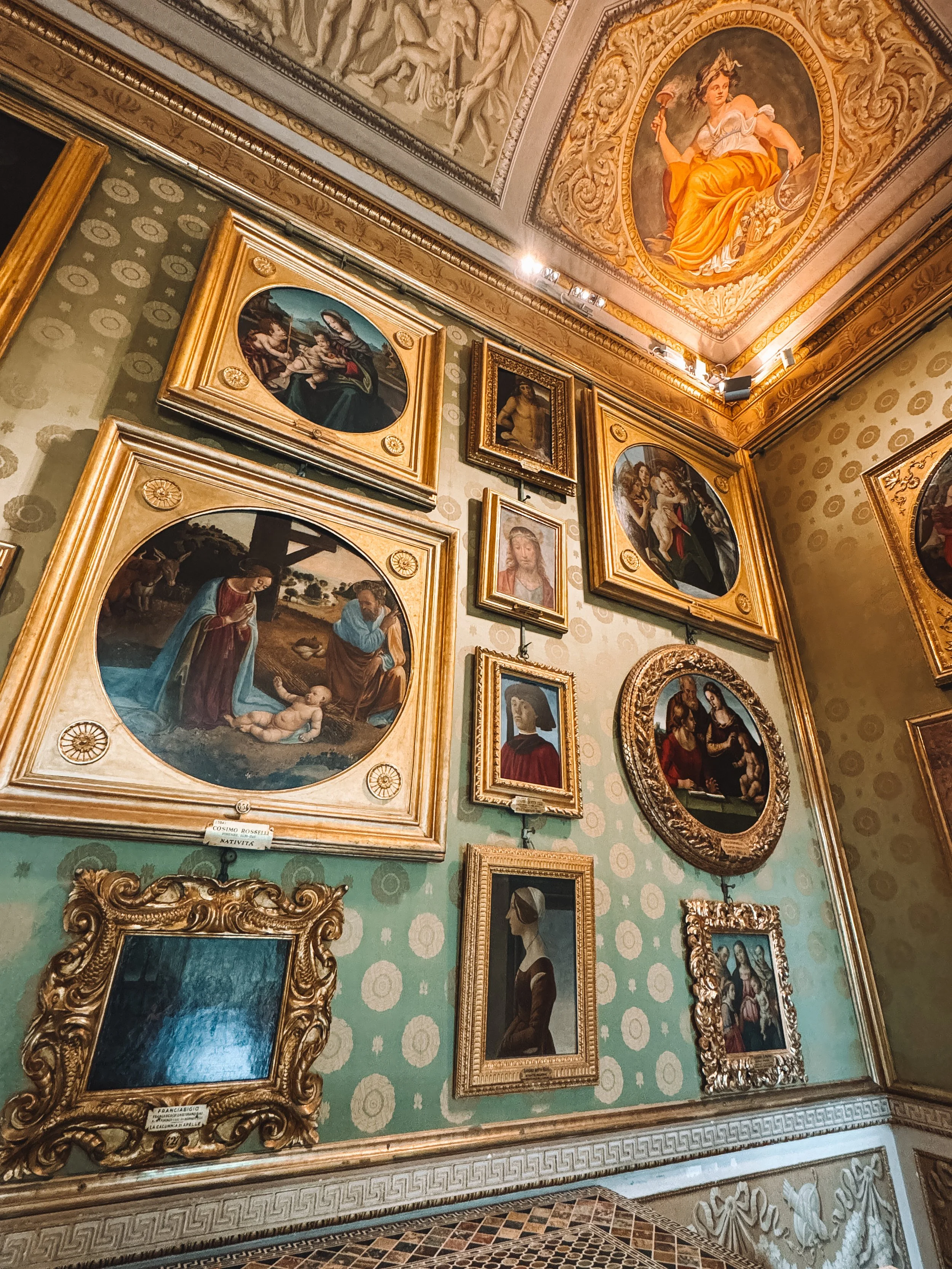
On the first floor of a former orphanage sits what is thought to be the first Botticelli painting. Like most of the collection there, it is a religious painting: the eyes of an angel stare out at those who pass by. Today, it sits behind a glass pane that is open on either side. Aside from its bulk, it would be relatively easy to steal.
Relative to the other Botticellis that sit around the city of Florence, that is. And I would know. I’ve looked at them all.
But I’m not thinking about stealing it today. I’m thinking about how it would have been stolen in 1966, sometime just before or just after the great flood that carried away tens of paintings that have never been recovered, and many more that are still being painstakingly cleaned and restored to this day.
I’ve become so accustomed to talking about stealing Botticellis, over the three years that I’ve been working on this book, that I don’t realise that it could be misconstrued by idle ears. I hadn’t thought about it at all, really, until I was eating lunch with a friend on a rooftop in Santo Spirito, chatting merrily about the merits of stealing from Palazzo Pitti over the Uffizi, and noted the waiters eyeing me with something between trepidation and confusion.
At this point, I’ve cased out every Botticelli in Florence. I’ve stared at Primavera hopefully, even though my mother was right all along about that one—it is far too big, spanning four large wooden panels. I’ve mapped out of the route from the Prometheus Room to the staircase that leads back to the courtyard and out to Piazza de’ Pitti. I’ve considered windows, gates, doors. If anyone could steal a Botticelli in 1960s Florence, it would be me.
(For the reassurance of any potential law enforcement reading this, and to avoid liability, I couldn’t begin to in 2020s Florence, what with the advent of security cameras, among other technologies. If any of them go missing, I had nothing to do with it.)
I’ve visited Florence five times now, even lived a couple of weeks in an apartment that was once the Botticelli family tannery, right next to where the man himself is buried in chiesa di San Salvatore. And in that time, two versions of the city have unfolded before me.
There is the Florence of today: with its Instagram hotspots and trendy little cocktail bars, and a perpetual line outside the viral eateries even though the same dish is served, probably better, at the three other, far quieter, places along the street. Despite its crowds, I love that Florence dearly. I love that I can slip away from the masses to the hidden corners I’ve found for myself there, fluent enough in Italian now to at least pretend to pass myself off as a local. I am always eager for any excuse to return, and rarely ready to leave when the time comes.
But there is another Florence that hides in plain sight: the one that exists within my book, a version of 1966 coloured by the characters I have added to it. By my useless little thief who really is trying to steal a Botticelli, with varying degrees of success.
In some places, these two versions merge, blurring around the edges until I forget which one is which. The little speakeasy bar I often visit there is one of these places; so much so that I forget which details about its real life owner are true, and which belong to the fictionalised version that lives in my story.
Chiesa di San Salvatore is another. Nestled in Ognissanti, aside from Botticelli’s paintings, it also houses his remains. A self-portrait sits by his tomb. Every time I have visited, there is a rose by the painting. I don’t know who replenishes it in this real version; in my fictional world, it is surely my thief’s grandmother.
I return to visit Botticelli on my last morning of my most recent trip. I am not religious, but I speak to Botticelli in that church almost as I imagine others might come to speak with God. In my fictional world, my thief would steal through the back door of the church, by way of the garden that is shared by the church and the neighbouring building, to do the same.
This book has been a labour of love like no other. I’ve never worked on anything for so long, with such relentless determination to actually keep working on it, over and over, rather than admitting defeat on a tangled draft. In the midst of other upcoming priorities, I won’t get to the rewrite I had planned on—that I had built this visit on—until likely next year.
But I know this Florence will remain for me, no matter what comes of the project, no matter how many years pass. Just as I know that I may never be able to look upon a Botticelli in a gallery without wondering how it might be smuggled out.