Feet on the Ground
“The purpose of life is to live it, to taste experience to the utmost, to reach out eagerly and without fear for newer and richer experience.”
Eleanor Roosevelt
It’s dawn outside the gates of the Taj Mahal. The ever-present smell of sewage that seems to permeate the city of Agra has followed you even here. The windows of the coffee shop across the street are painfully bright in the low light that precedes sunrise. The voices of the vendors from the small trinket shops carry down the alley. The crowds gather, the line surely snaking far beyond what you can see.
The gates open. There is rush toward the turnstiles. Elbows shoved into ribs to get through first. Arguments with the security guards when codes don’t scan. An elderly woman is becoming increasingly panicked—she’s lost her tour guide somewhere in the masses. You make it through one gate to the security checkpoint. Guides yell to keep hold of your valuables. Your now practically empty bag is tossed into a pile for inspection; you keep your phone, wallet, and passport clutched tight to your chest.
All of this, to make it through in time to see the glow of sunrise catch on the gleaming marble of the Taj Mahal. Which you will, although you will do so crammed shoulder-to-shoulder with the several hundred other people who had the same idea.
But it is still a marvel. It glitters in its pristine cleanliness, such contrast to the dusty streets outside. You can almost forget the smell that has creeped in with the crowds from outside.
It’s when you take your eyes off the wonder before you that you’ll notice it. That not one other person appears to be looking at the building at all—at least, not directly. Not unless it is through a camera lens. Not unless it is as they pose, back to the camera, colourful India silks billowing behind them.
I am just as bad. I have several hundred photos of myself by the time we leave—many of them are awful, but even the condensed collection is the double digits. It’s impossible not to get caught up in it, when all you see is others taking their photo before the monument. It seems oddly natural; like it’s what you ought to do.
But I leave with this strange, contorted feeling in my gut. As though I hadn’t really seen it at all, despite the extensive photographic evidence to the contrary.
It’s a feeling I’ll have throughout my travels in Asia: a sense of disconnect from the places I have visited, perpetrated by this odd need to capture it all through my silly little phone. I start to become more aware of it, to consciously put my phone away, and actually look at the places I visit. To root my feet to the ground and engage with the presence of my surroundings, rather than to worry that I will not best capture it in photos—photos I will only look at once in a blue moon.
These efforts are challenged, constantly. The human societal desire to fit in makes my fingers itch for my phone when others take theirs to the view; to envy the nice photos they take of one another and think, but wouldn’t I like that, too?
Then there are the tour guides—or, as they inevitably become, personal photographers—who point out this place and that spot and another view of there, all of which they insist you must have your photo taken with. More than once I end up being the only one on a day tour, or one of only a few, and it feels there is no escape from it. I grow weary of politely declining photo opportunities; of being corralled into standing just there, and looking just so, until I start to feel like a volunteer model rather than a paying visitor.
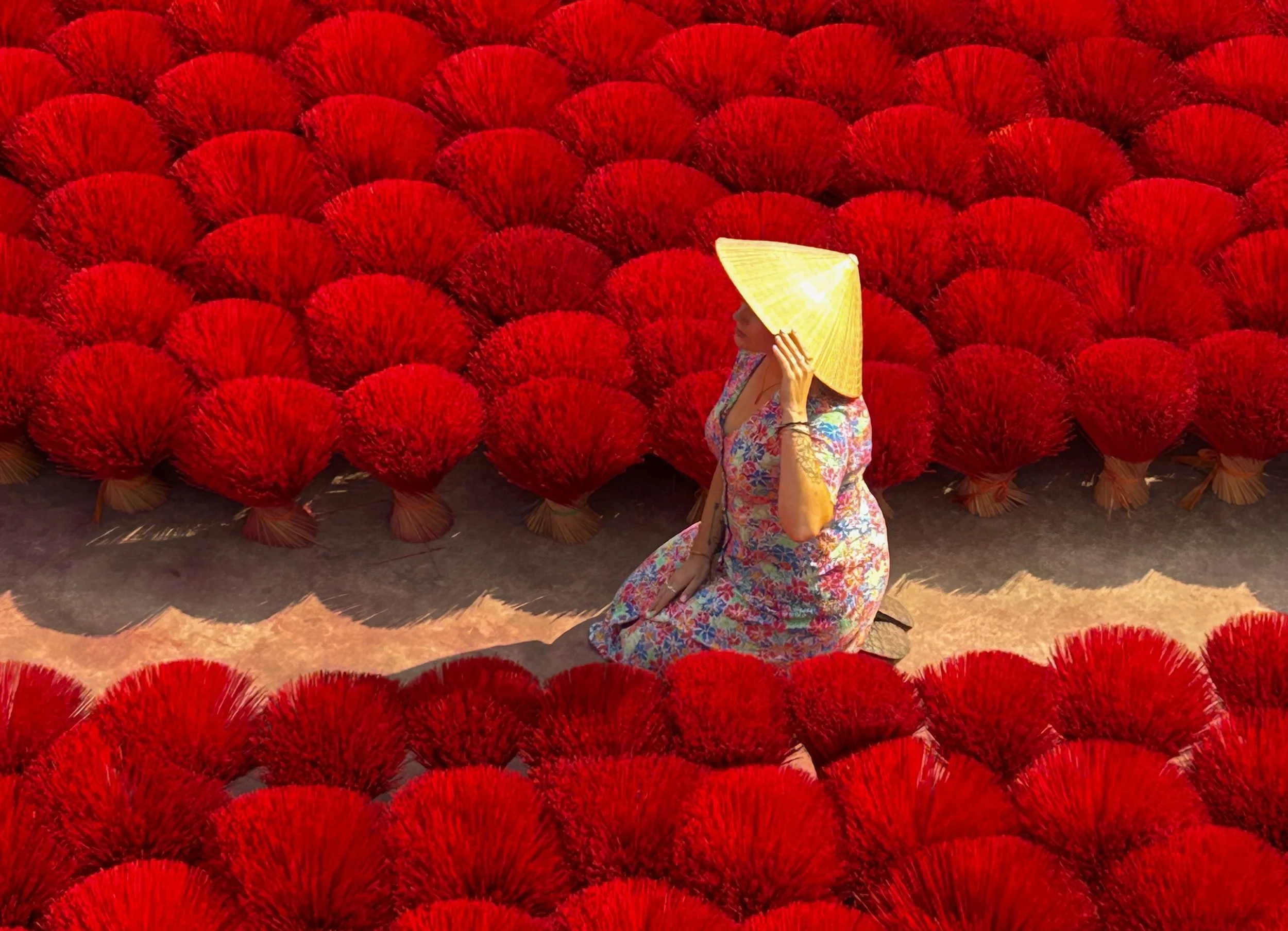
And then there are the places that seem to have been crafted solely for the purpose of standing as a background to a tourist’s curated social media feed. Take the incense village outside of Hanoi: I had seen the photos. I had fallen for the clever camera angles, thinking it to be a vast, colourful field. A working one, surely.
It is almost enough to make me laugh when what I am brought to is little more than a converted car park. Brightly coloured incense sticks stretch out in all directions, carefully curated into swirling patterns and floral imagery. The concrete walls enclosing the space have been splashed with murals of dense forests, completing the facade.
And to ensure the very best angles, a variety of ladders and platforms have been erected, so that you too might have your photo taken, and have it look just like the natural space it never was. And so, to entice the next batch of tourists, and the next, and the next.
I can’t blame the locals for this: it is innovative, and the money they make from it is pennies to the foreigner, yet meaningful to them. Far more than they likely make from selling the incense itself, not to mention the laborious process that comes with it.
Yet it makes me uneasy. Not the money of it all, but the experience. My tour guide that day is a fountain of historical information and answers every question I have without hesitation. Even the political ones. But it’s the answer to one question in particular that will stay with me in the weeks to follow.
We’re standing by the riverside in Ninh Binh as an endless stream of rickety metal boats sail past, their rowers lounging back as they guide the oars with their feet.
“What was this river used for, before the tourists came?”
Their passengers pose with the intricate rock structures behind them, discarding their lifejackets. (Fluorescent orange doesn’t go with the aesthetic. The rowers don’t seem to care.)
My guide’s answer is simple. Direct. “It wasn’t,” he says, and then guides me back to the car to start our journey back to the city.
It’s an odd picture of travel in this modern age. Who am I to deny the locals whatever extra income they might generate from photo-first tourists? And who am I to dictate how people spend their holiday, for which they may have saved for and dreamed of for so long?
But maybe, if I can offer only one piece of advice, after my many years of travelling, it is this. Take some time to root your feet to the ground and experience the place you are in, without worrying of the photographic mementos you might miss out on in the meantime. For if you do take a photo, then it might pull you to a memory. Of the sun on your face. Of the scent of blossoms in the air. Of the itch of a mosquito bite on your ankle.
Rather the memory, than an empty image, however perfect it might appear.