On Ancient Paths
“It is in our nature to explore, to reach out into the unknown. The only true failure would be not to explore at all.”
Ernest Shackleton
It often feels a taboo to say you dislike a place while travelling; as though every place ought to speak to us somehow, every place bring us some grand revelation or adventure. Phnom Penh brings me neither. I spend a few uneventful days there, catching up on writing and inciting a mild panic when I accidentally toss my phone into the rooftop swimming pool. It’s a relief to board the sweaty bus north to Siem Reap – the place I’d really come to Cambodia for.
The city fades behind us into small villages dotted against wide open fields. I pass the hours snoozing, or talking with my new Spanish magician friend I meet on the bus. The sun is shining, bright and intense, and the haze of the city has lifted, the one that had left me melancholy and lonesome in those few days down south in Phnom Penh.
At the bus station, I am met by a tuktuk driver from my hotel and whizzed, luggage and all, through the wide, empty streets of Siem Reap toward my accommodation. It is quiet here, surprisingly so – I would come to find the city often was during the day, and only at night did the streets turn out the bustle that I had expected of such a destination. I rarely stayed out at night, preferring to wander through the quiet of the afternoon, stopping for coffee along the river’s edge or bargaining in the market with the friendly vendors, free from the crowds that would come later.
But I wasn’t even here for the town, not really. Just a short drive from where I was staying sat the Angkor Wat complex of ancient temples. I wasn’t actually here for those either, but it was a good place to start.
It is still pitch dark when we arrive, sunrise not yet tempting the horizon. The stars and sliver of a new moon hang above, but they do not provide much in the way of light, and I have to watch my steps carefully as I navigate the worn stones that protrude from the thick grass. I’m so busy trying to make sure I don’t stumble up the steps through one of the gates into Angkor Wat that I don’t see the statue until I am right before it.
I stop short, gazing up at the statue of Vishnu draped in bright robes, illuminated only by the light from someone’s torch. The beam seems to catch on their jaunty smile, as though welcoming me in. I bow my head, and continue past.
The sunrise over Angkor Wat is slow and gentle, until the final burst of light illuminates the whole structure. It is busy, certainly, but it is not the kind of busy that I have experienced before at such famous landmarks; at the Taj Mahals and Eiffel Towers of the world. I look over the figures huddled by the edge of the water, pink rays of early morning light catching on their faces as they wait for the temple to appear. For this brief moment, we are all interconnected in this space; all entwined in the here and now of watching the sun greet the temple, and the day.
The day that dawns is hot, increasingly so as we move from temple to temple within the sprawling complex. I’ve written before of growing up wanting to be Lara Croft, but the so-called “Tomb Raider temple”, Ta Phrom, quickly becomes one of my least favourites of the day. The tree roots seem to fight against the structure of the building, and the tight passages make the modest crowds feel oppressive.
Besides, I know the true Tomb Raider temples are those I will see the following day, only found by venturing further into the jungle.
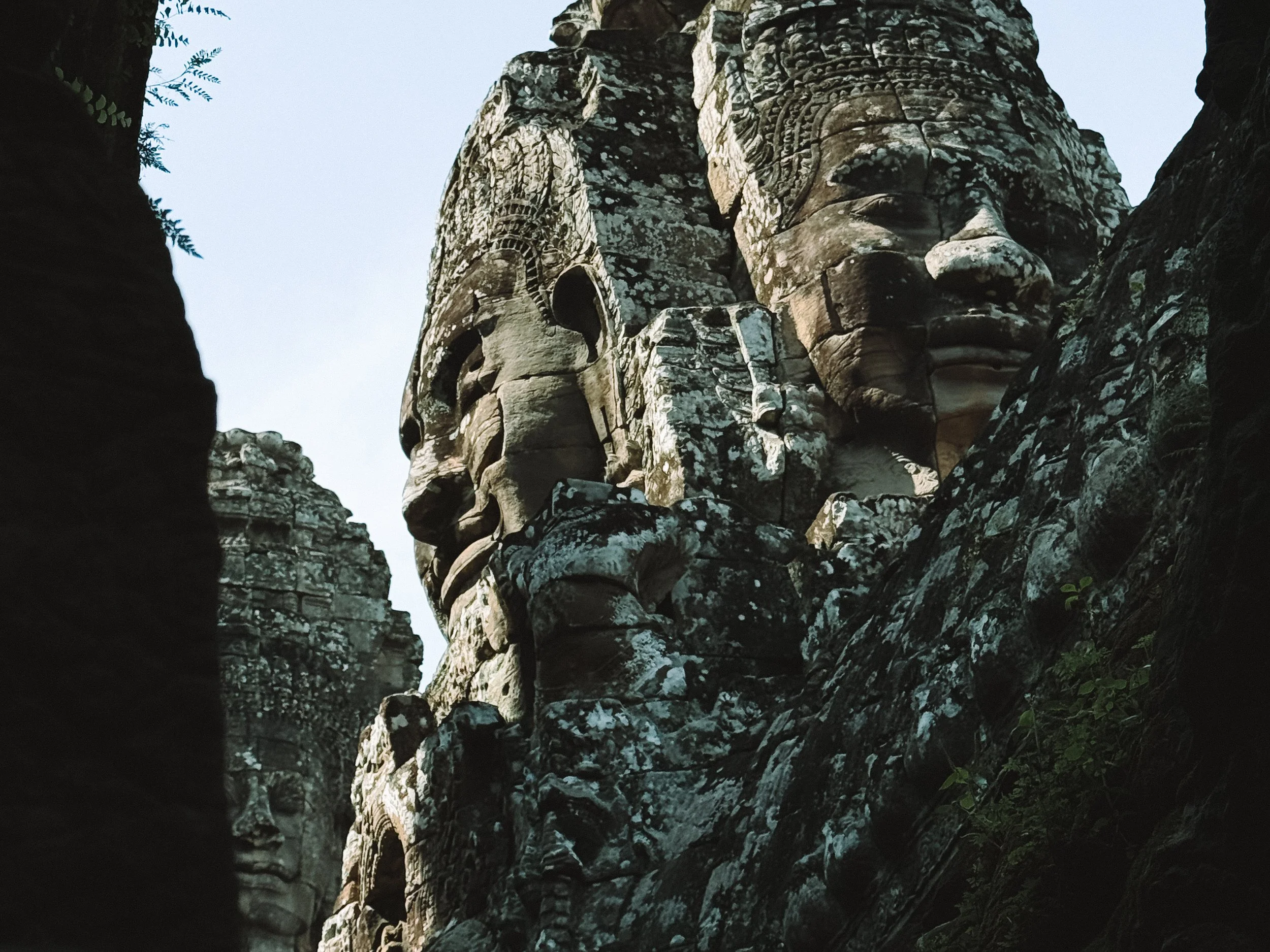
Yet the Angkor Wat complex is not to be dismissed as a tourist attraction. Stepping within the passages of Bayon Temple is to walk on ancient paths. The smiling faces carved into the rock faces beam down upon us, their ever-present gazes watching our careful steps over uneven stones and crumbling archways. These same faces that have looked upon generations on generations. In a world that seems so ephemeral, that places like this remain staggers me.
It is nothing compared to the feeling I will have the next day. Prasat Pram is a small collection of structures within the Koh Ker complex, and the very thing I came to Cambodia for. I stumbled upon a photo of it, five or six years ago, and haven’t been able to get it out of my head since.
Here, the trees do not fight against the structures but seem to coexist. The long roots are wound around the stone, in harmony with one another, keeping fragile stone grounded to the earth even as the years pass.
Within Koh Ker, there are many structures that are not so well preserved as this. Walls long since fallen to pieces; statues and figureheads looted by treasure hunters. Many of them are small, and in their state of disrepair, you can only peer from the outside.
At Beng Melea, my last stop, the destruction is immense – but so too are the remaining passageways that exist within the complex. I tiptoe along a narrow edge of rock that protrudes from the wall, and hop over a tree-stump walkway that has been fashioned to allow access out of the water-ridden lower sections.
I’ve never quite been able to explain what it is that makes me long to explore, to venture past the charted and into the unknown, but I’ve never felt more like the adventurer I’ll never quite get to be than standing among these structures. Unlike Lara Croft, I’ll keep to the dangers being a few lazy grass snakes and the occasional warning sign for landmines. For my mother’s sake, if nothing else.