A Decadence on the Senses: Welcome to India
“India is a place where color is doubly bright. Pinks that scald your eyes, blues you could drown in.”
Kiran Millwood Hargave
One of the great discomforts of travelling is those first few hours in a new place. It’s not the travelling itself, although your journey may have been long or uncomfortable; it’s not the jet lag, although you may have turned time zones to get where you are now. It’s the gap between having physically landed somewhere before you have mentally caught up to your surroundings. That stage where you pass through the streets of this new place, the world a fresh, bewildered blur as you struggle to adjust to the where you are now, and all the new and different that that can bring.
I’m well-used to this feeling. In some ways, I think it is a necessity of travel: an important part of the adjustment to a new location is to feel uncomfortable; to remember that it is your job as the visitor to adapt to the place, not theirs to adapt to your preconceived tastes or notions of where you are. I’ve experienced it in varying degrees, from the overwhelming streets of Giza that kept me confined to my hotel on the first night, to the more familiar winding alleys of Rome that I explored with a projected confidence that I didn’t necessarily yet feel.
Nowhere have I experienced it more acutely than in Delhi. Even the first views from high up in the plane on our descent tell me this is a place unlike any I’ve been to before. The densely packed streets, that seem too narrow for people to actually live in. The vastness of it all. The snaking lines of the roads. And once on the ground, weaving through traffic from the airport, it is somehow exactly what I expected of the Indian capital and yet entirely too much all at once.
Like Cairo to Egypt, I soon learned that Delhi was not the part of India I was going to fall in love with. With the additional pressures of pre-Diwali traffic and crowds, it is an assault on the senses. The noise is relentless. The heat pools into the tightly packed streets. The air is thick with the fumes of the raging traffic. And amidst it all, people weaving through with no sense of order to be found amongst the chaos.
By the end of our first full day, my head is pounding, my body exhausted, even though I don’t feel as though I’ve really done anything in the ten hours I’ve been trekked through corners of the city.
The night will bring no more peace, crammed into the top bunk in a sleeper carriage with nothing but a thin curtain separating me from the rest of the crowded car. I am right by the door and each time it opens, the curtain breezes open. All night, an array of people peek through: fellow passengers, sometimes; vendors, other times, calling out their wares. Socks, slices of pizza, or ice cream into the night; chai and coffee come the morning.
By the time we reach Udaipur, I fear I have made a mistake. I fear that India is too much, even for me, even with how much I have travelled, even with the added security of the group I am with. I am exhausted and overwhelmed and beaten down by Delhi and the overnight journey.
I sit on the edge of my bed in Udaipur and stare out at the palace atop the hill, the lush greenery around it. It is far quieter here, not least where we are on the outskirts of the old quarter. It is not quiet – still, the horns blare and the tuktuk traffic is plentiful. But in comparison to Delhi, it could almost be described as peaceful.
Fortunately, Udaipur brings with it not only peace, but a kind of magic. I am still tired, still adjusting to India, but I feel myself relax as we wander the winding streets of the old quarter. The little shops that line the way. The temple from which bells ring at various times through the day, the echoes of of which cascade down either end of the street like birdsong. The junction at the top of the road that leads from our hotel, something entirely comforting about its complete chaos as it functions as something between a roundabout and a four-way crossing, overlooked by the larger Jagdish Temple.
It is on that road, as I walk back to the hotel in the late afternoon from a fascinating day of talking with a local artist, that it comes over me. The feeling that I have finally landed. My feet are back on solid ground; my rhythm now matched to the pace of the country I am in. To be able to walk down the street, navigating around the two-wheelers and the tuktuk drivers without panic or distress. To smile at the vendors or stop in to buy something small to eat or drink. It is a grounding. It is a reminder. I am where I am meant to be.
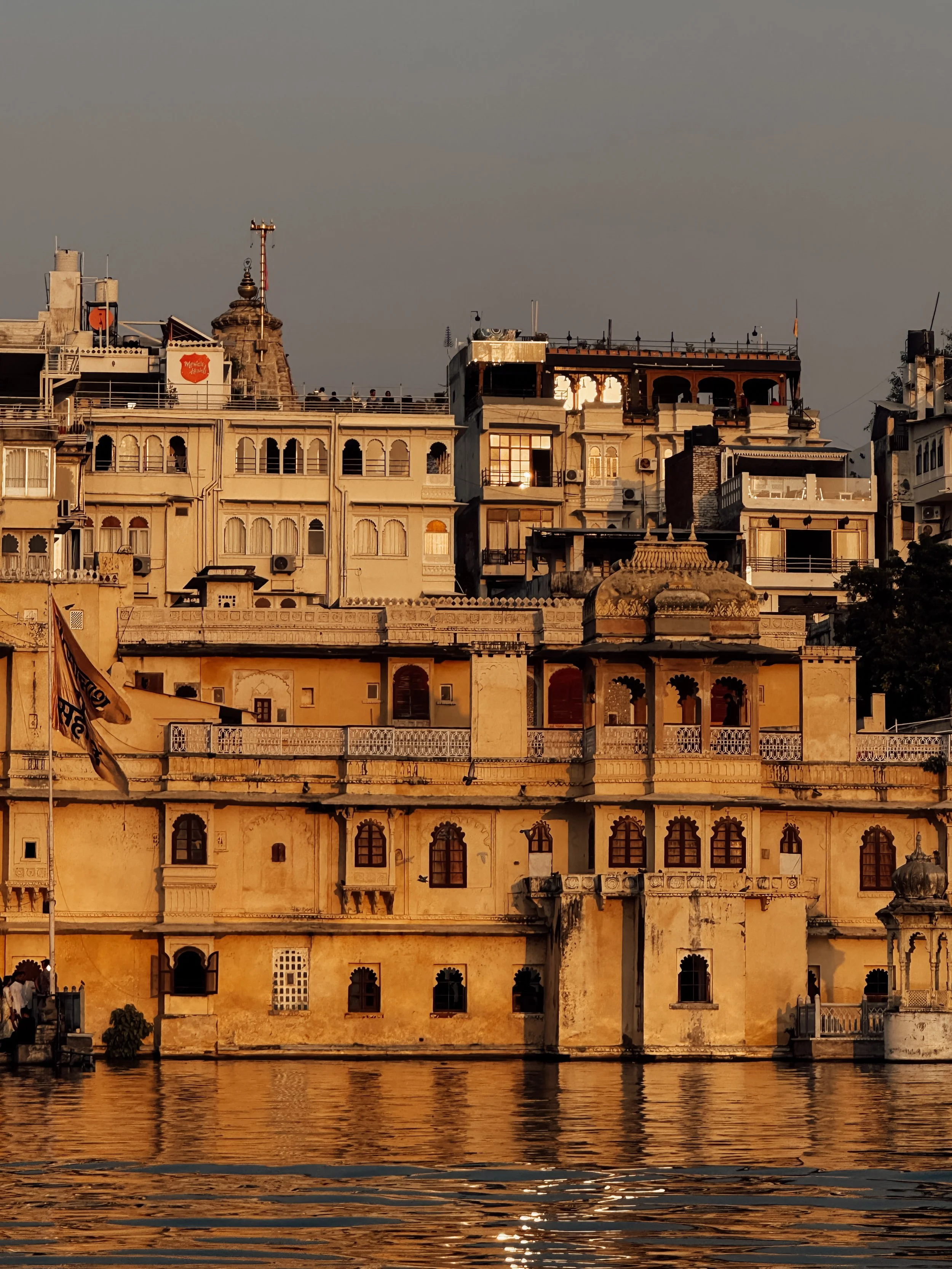
Udaipur holds such beauty where it sits by the water. They call it the Venice of the East and I can quickly see why. I have only two days there and yet I know I will return. As I say: there is a kind of magic there. Not to mention an offer of a room whenever I would like it, and a quiet rooftop overlooking the old quarter where I could write.
Against the architecture of the old palace sits too the modern side of India that I am beginning to notice, in contrast to what I had expected from the country. It seems foolish to say it: of course India too is modern, growing with the rest of the fast-paced world. But we think of the historic monuments, the temples, the palaces. We forget that we are travelling in place, not in time.
We spend our last night at a trendy rooftop bar and restaurant towering over the old quarter. The first Diwali fireworks are beginning to appear on the night sky. The buildings that line the water’s edge are lit up, reflected in the dark pools below. If I closed my eyes, a cocktail in one hand and the thrumming bass of the music around me, I could be in any rooftop bar in any major city in the world. This, too, is part of India.
The staff are impossibly accommodating, as I’ve found almost everyone to be here – I’m not sure if this is because we are foreigners, or simply the service standard. I’ve yet to see any women working in any of the service industries, always an array of men a glance away to bring us whatever we’d like.
When it’s time to leave, we have a short walk down the road to where the tuktuks will collect us. A familiarly handsome man whizzes past me on a motorbike – the bar manager, who is well-dressed and charming and already had half of our group swooning. By the time we reach the meeting point, he is there, motorbike nowhere in sight, composed and awaiting to escort us to our rides, like a hero from a Bollywood film.
“We just left you at the bar – how are you now here?” I ask, even though it’s a silly question when I saw exactly how (I was unapologetically part of Team Swooning).
He doesn’t answer the question exactly, simply offering me a crinkled smile. “I’m here to make sure you get back safely.” And that he does, escorting us in groups of three into tuktuks.
We leave in the morning, bidding farewell to the city that has forever tied me to India. I have many cities like this, those that tether me to them even when I am miles away, even if I may visit only rarely. Florence is one, a city I’ve written of many times. New York, another. Udaipur, a new addition.
But for now, it was farewell, as Diwali celebrations grew closer.