Find Me In the Stacks
I’ve often anecdotally said that I grew up in a house where children’s books were quoted over the dinner table. While very true, in addition, it was also often the site of complex, and occasionally philosophical, discussion. We’re an academic family, made up of teachers and scholars and students, and learning was always encouraged. Questions, equally so.
It was the kind of household where questions about the rotation of the planets led to demonstrations involving props from the fruit bowl. The kind of household where I spent summer holidays with my older brother teaching me how to multiply fractions, five years before I’d get taught it in school. The kind of household where an answer was given due diligence – and if my parents didn’t have one, I was promptly sent to the collection of encyclopaedias to find out for myself.
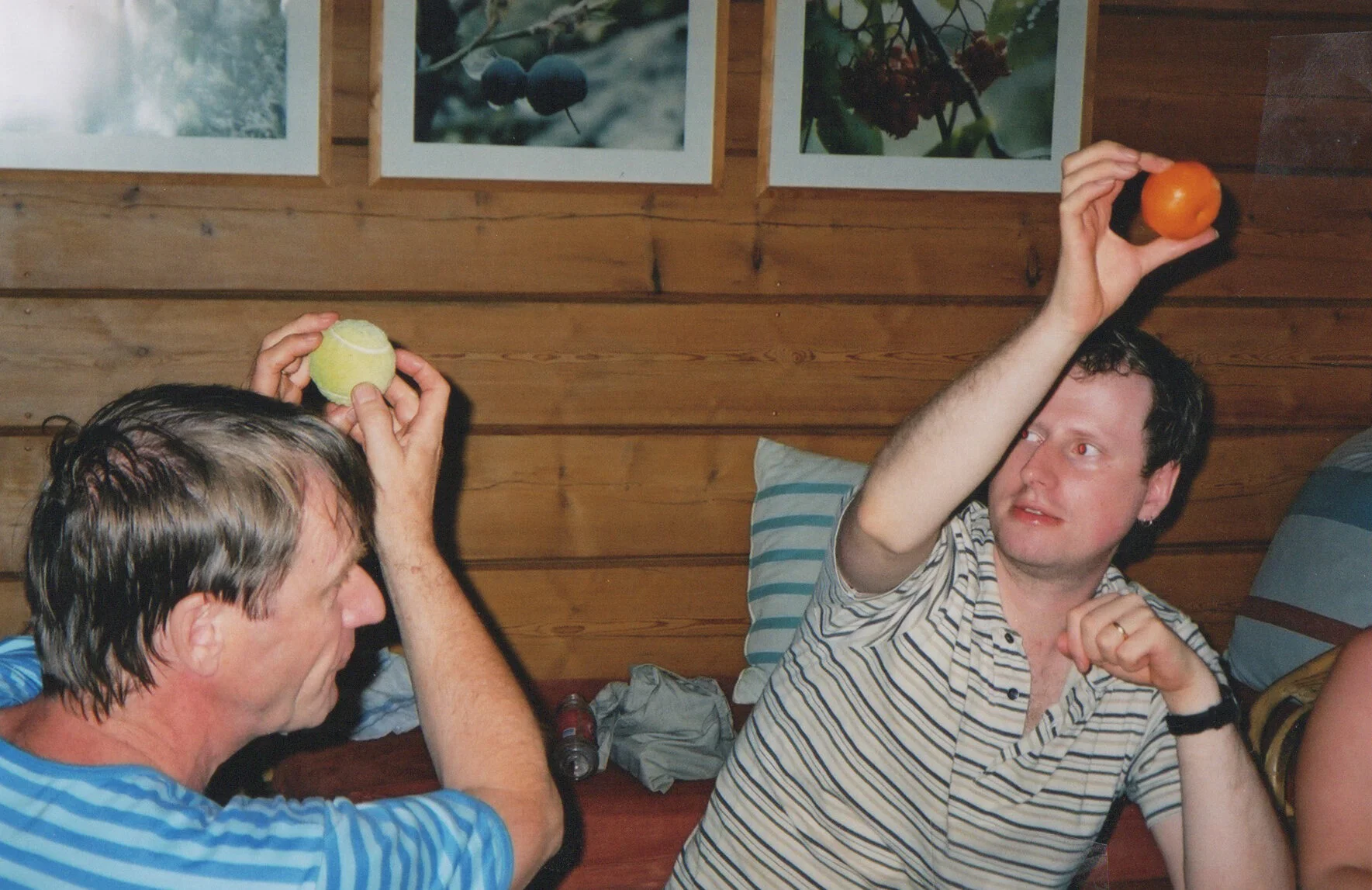
(The clementine is the sun).
It hadn’t even occurred to me that this was perhaps a unique kind of upbringing until later in life. I remember, a couple of years ago, standing in a fake library set-up in an immersive escape room, suddenly realising the clues led to the encyclopaedias lining the walls. I announced this and found two teenagers staring back at me blankly.
“What’s an encyclopaedia?”
I hesitated. “It’s like Wikipedia but… A bunch of books?”
(They were unimpressed).
Although I did not pursue academia or teaching, this part of my upbringing has had more of an impact on my life than I often take the time to acknowledge. I’ve been writing historical fiction for some five or six years now – longer, I suppose, if you include the play I wrote in high school although I think the research on that project was minimal, at best. Before pen even touches paper, those stories take me to the stacks to hunt out as much as I can on the subject before I begin. It’s not just about historical accuracy, although that has a huge place in its own right. Without getting as immersive a feel for a time as I can without the invention of a time machine, I can’t settle into the writing of it.
One of the earliest joys of working on my pirate novel was the discovery of a book in the university library. It was covered in a thick layer of dust and, according to the records, hadn’t been checked out since 1972. It was a far cry from the generic, and often ill-informed, information that gets thrown around about pirates, and even included snippets from the articles of genuine pirate ships that informed much of the background for my book.
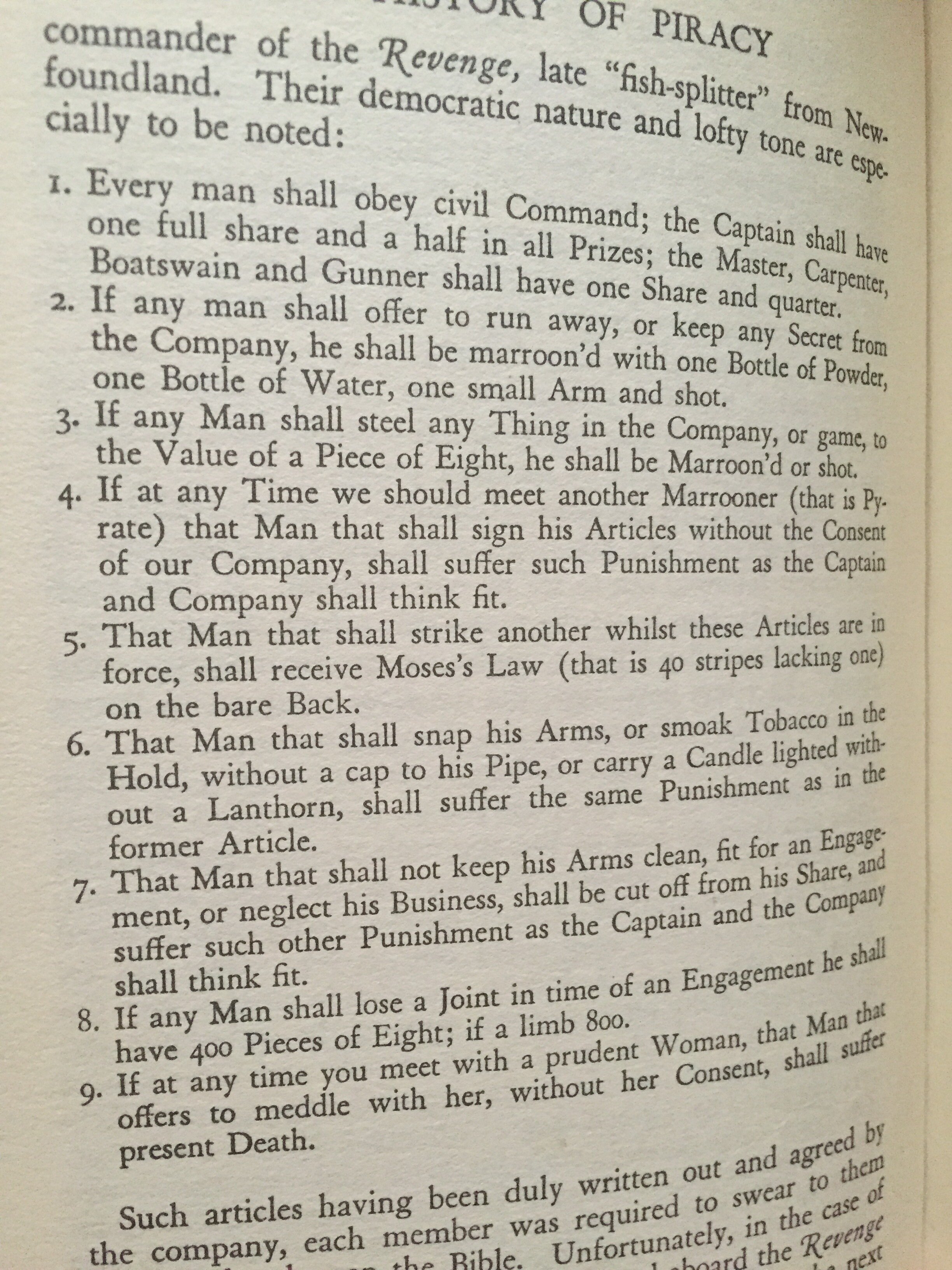
Note Article 9 in particular…
I have been known to get a bit lost in a time period during this process. I disappear off into a sea of films, music, and literature of the time, and will sprout off random facts to just about anyone that will listen. When I was settled in the 1920s, I wonder if this was less annoying. I’m sure that everyone around me will be glad that I’m starting a new project, in a new decade, next month, and that they won’t have to hear about 18th century pirates anymore.
(If you want to hear more about my process in writing historicals, check out the podcast episode I was featured on with some of my fellow historical fiction authors from Interlude Press here).
Certainly, I always largely enjoyed school and university but when I graduated in 2017, after thirteen years of schooling and five years of higher education, I was ready to be out, at least for the time being. I’ve considered further education many times, both when I was finishing up my degree, and in the years since. I’ve just never been quite sure what it is I would go back to school for.
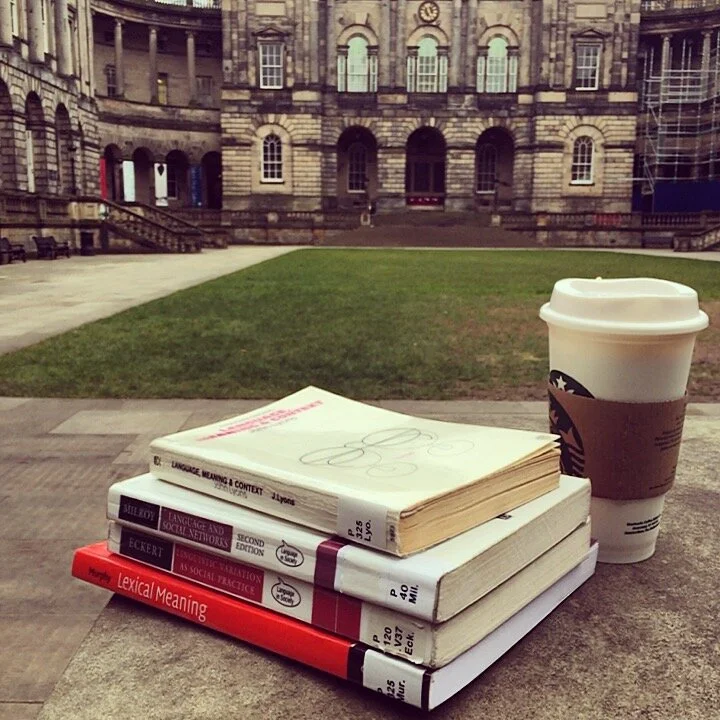
I often have a pang of nostalgia for student life.
Unlike my undergraduate degree, where choosing a subject to study, as for many 17 year olds, was a bit on a whim, I see further education as requiring a bit more deliberation. I studied Linguistics at undergraduate level because I liked maths and I liked language. I’m not a linguist, now. But I’m also now 26 years old. I can’t go back to education because something seems interesting – the time and money that I would have to sink in requires me to have at least some idea of why that subject would be beneficial or serve a purpose to my career or life in some way.
In the past year, perhaps in part due to my work being predominantly contractual and rarely stable, I started to think more seriously about returning to education. Even then, with a few years’ of work experience under my belt and seemingly some more idea of what it was I wanted to do, I couldn’t nail down what it is I would study. I found a course on Entertainment Business at the Los Angeles Film School that for a solid week I was convinced was perfect for me. I attended an information session for the Vancouver Film School which I quickly decided against.
Was it even that I wanted to go back into education, or was it that I was just longing for someone to tell me what to do for a bit? Longing for some way to take the pressure off of myself to make decisions about what came next all the time and have at least a year mapped out for me and some space to breathe.
Nine months ago, I was quite seriously considering going to UCLA to do a Masters in Visual Anthropology. This wasn’t completely wild – it fit with my film background and sociological interest, and with an anthropologist for a father, it was a discipline that I’ve grown up around. But I knew I couldn’t do it with at least some idea of what came afterwards – what was it that I wanted to do that would benefit from this?
I hadn’t come to an answer when the pandemic hit and the idea of spending any extended length of time in the U.S. in the coming years seemed unlikely.
As we settled into lockdown life, having lost my job early on, I knew I needed projects. I’m not the kind of person that can sit around for extended periods of time not doing anything. I need tangible goals and achievements; I need to tick things off a to-do list. In amongst other things, I signed up for a free online course on Coursera.
It was incredible how quickly these few hours a week spent learning filled the hole I hadn’t totally realised was there. I get a real joy and satisfaction from learning but it didn’t need to come in the form of hours and hours out of a week or thousands in debt. I finished up my first course on The Science of Well-Being and, later in the summer, moved onto Indigenous Canada. In the past, much of my learning was focused on the accumulation of knowledge. These courses also brought a purposeful development – not to my career so much as to me as a person.
Next on my list is coding, a bit of a return towards skills-based learning than personal development. I’m not quite sure when I’ll start that given that I recently got accepted onto a six month film career accelerator course. For the second time in my life, I’m sort of going to film school without actually going to film school – the first, a week-long summer course I took in New York when I was 19 years old. That week was the first time in my life I began to think seriously about whether I could pursue a career in the industry that has become a huge part of my life. I’m beyond excited to get back to it (and incredibly grateful for the gentle time commitment and government funding that’s covering the cost).
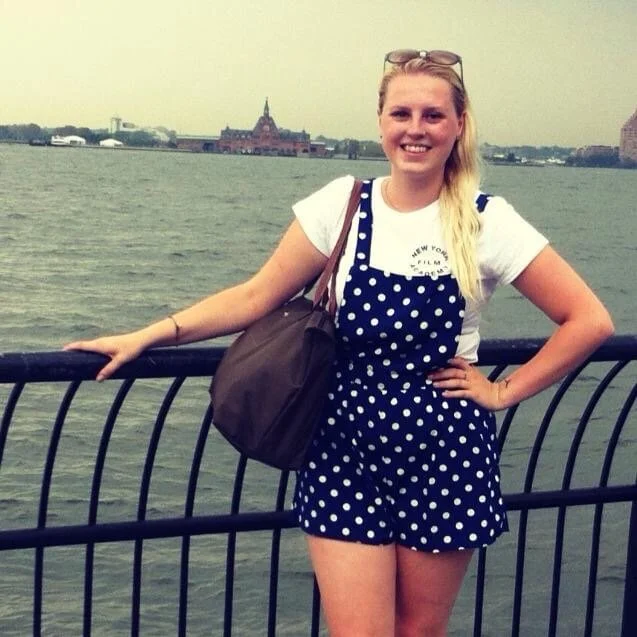
Let loose in New York, not quite going to film school (2013).
One of the things I learned in my course on The Science of Well-Being was about signature strengths. According to the VIA Institute on Character, signature strengths are qualities of your personality that are most important to you and central to your identity. They are often considered to be essential to who you are as a person, effortless, and energising. The idea is that in this list of qualities, every person will rank in a different order from a personality test, with those at the top of the list most vital to you. Using our signature strengths frequently is supposed to boost our mental well-being and overall happiness.
My top four signature strengths are: kindness, creativity, curiosity, and…
Love of learning.